

A student opens an assignment. A developer opens a backlog. Both now face a question that goes beyond getting the work done: what should I learn to do myself when an AI can produce a convincing first attempt?
Compare engineering career paths, decide what to keep learning, and try the campus-assistant project brief, downloadable test cases, and a review worksheet to build evidence of your skills.
Part 1 examined GPT-6 Astra, Claude Fable 5.1, and the AGI debate. Here, the focus is work, learning, and collaboration. The research describes specific studies and forecasts. The longer-range illustrations show possible futures, and the science fiction examples are interpretations rather than predictions.
Choose a small problem, use AI where it helps, and keep a record of the decisions you checked yourself.
AI singularity and AI supremacy: what do they mean?
IBM describes the technological singularity as a hypothetical period of runaway technological change, often associated with AI improving itself. It concerns what happens to our ability to anticipate change. Artificial superintelligence, or ASI, concerns capabilities beyond human intelligence. The ideas are related, but one does not establish the other’s timetable.
“AI supremacy” can refer to several different concerns. Keep these three questions separate:
Capability
Can a system outperform people at a particular task, or across many tasks?
Dependence
What happens when essential services rely on systems people struggle to inspect or replace?
Power
Who owns the infrastructure, sets the objectives, and can challenge a decision?
A high test score answers only part of the first question. It grants no moral authority. The February 2026 International AI Safety Report treats loss of control as an uncertain risk involving capabilities, behavior, and access to real systems. That assessment predates the September model launches discussed in Part 1.
Before connecting a model to a codebase, decide what it can do. Reading files, deploying changes, managing payments, and deciding who receives a service carry different responsibilities. Make those permissions visible and name the person responsible for reviewing them.
What optimism about AI means for people
I’m drawn to Sam Altman’s vision of AI expanding human agency. I want it to help a student understand a difficult subject or a small team build something useful. That’s a direction I’d like to work toward. It doesn’t tell us how close a singularity might be.
In The Gentle Singularity (June 2025), Altman imagines more abundant intelligence and energy while people continue choosing goals, creating, and finding meaning with others. His speculative vision of the 2030s depends on alignment and widely distributed access. It is not an established timetable. His earlier Three Observations emphasizes agency and adaptability, while arguing that broad benefits require deliberate choices about access and power.
Dario Amodei’s Machines of Loving Grace describes another possibility: powerful AI could accelerate health research, while relationships and personal achievement retain meaning. He also describes physical and institutional bottlenecks. His scenario assumes powerful AI already exists. It does not establish when those benefits arrive.
For engineers, Greg Brockman’s 2022 essay It’s time to become an ML engineer connects progress to software infrastructure, machine learning knowledge, and willingness to revise familiar assumptions. It describes engineering and research as complementary work. Read it as a perspective on skills, not a guarantee of employment or a requirement that everyone change roles.
For a student or engineer, there’s a useful question here: after using the tool, can you explain the decision, challenge the result, and tackle a new problem? Finishing sooner is only part of the answer.
People choose goals
Learning
Explain and question.
Building
Design and verify.
Research
Experiment and reproduce.
Try a problem with and without AI
Use the campus-assistant fixture below for this proposed learning exercise. Its documents are synthetic. This is a way to examine your process, not a completed study or a model benchmark.
- 01 / WORK SOLO
Explain the deadline
Read the current and archived handbooks without AI. Explain why 30 September applies instead of 31 October. Cite the current document. Answer the fee question using only the supplied evidence. Say clearly when the information is missing.
- 02 / USE AI
Check the model’s answer
Ask a model to answer the same questions from those documents. Keep its prompt, response, model name, and date. Check every citation and record where you accepted or rejected its reasoning. Revise your explanation in your own words.
- 03 / TRANSFER
Answer a different question
Ask a study partner to create another fictional handbook excerpt with a changed rule or missing detail. Close the chat and answer it. Explain which evidence controls the decision and when you should ask for clarification. Compare how you reached each answer.
Keep all three responses in your portfolio. Add notes on what you knew, what the model helped you change, and what you could explain independently afterward.
Human–AI evolution through skills, tools, and institutions
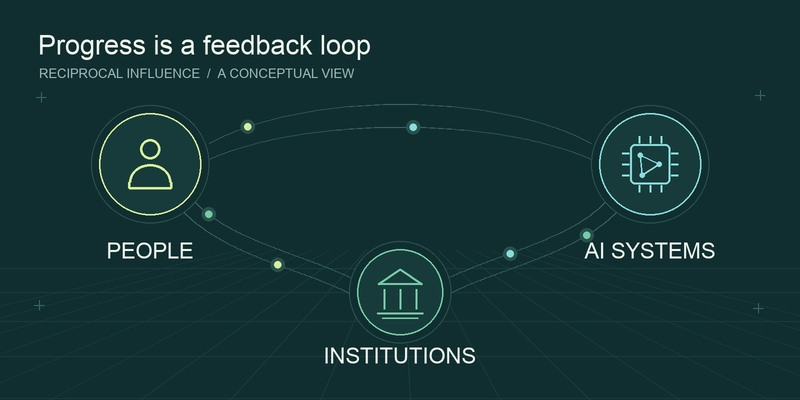
Here, human “evolution” means changes in skills, tools, and institutions. It does not assume that people must merge biologically with machines to keep up. A society can become more capable through better education, more accessible software, and better ways of coordinating work.
How people could adapt to stronger AI
Extend what we can do
Help with tasks, alongside specialized tools that restore or support abilities.
Human adaptationLearn the tools. Check their output. Preserve independent judgment.
Coordinate more work
Broader delegation across people, agents, and organizations.
Human adaptationDecide who owns the work, who can act, and how people can review or challenge decisions.
Live with stronger systems
AGI or ASI could develop, but its capabilities, adoption, and consequences remain uncertain.
Human adaptationKeep access, education, consent, and public accountability central.
One example comes from a 2025 Nature Neuroscience study that used brain recordings and deep learning to stream synthesized speech for a clinical-trial participant who could not speak because of severe paralysis. This was assistive communication in a trial participant. It did not demonstrate general cognitive enhancement.
Restoring communication gives this work a concrete purpose, regardless of whether broader forms of enhancement become possible.
Human–AI collaboration has its own limits. A 2024 meta-analysis of 106 experiments found that human–AI combinations improved on humans alone on average, yet did not outperform the better of the human or AI working alone. The studies covered 2020–2023. They do not measure today’s frontier models.
For a product team, assign responsibilities and test the handoffs. Give reviewers enough time and information to question a result. An “approve” button does little if the person clicking it cannot assess the work.
Job growth and AI exposure measure different things
Two questions often get mixed together: how the labor market might change, and which tasks AI could affect. These charts measure different things. Neither is a countdown to the disappearance of software engineers.
Jobs expected to be created and displaced
Projected roles in WEF’s covered employment dataset, 2025–2030 · millions
The WEF survey drew on more than 1,000 employers. Its outlook lists both AI and machine learning specialists and software and application developers among fast-growing roles. That supports preparing for several engineering paths. It does not establish that one job title will replace another. Read the jobs outlook.
Exposure to generative AI varies by economy
Share of employment with some exposure to generative AI · ILO, 2025
ILO’s analysis emphasizes transformation because occupations contain tasks that still need human input. Exposure also varies by the kinds of work an economy contains. The same technology can therefore create different training needs in different places. Read the exposure study.
At the team level, measure completed work. Drafting speed can hide time spent checking, fixing, integrating, and maintaining a change. METR’s February 2026 update explains how selection effects and changing work patterns made its newer developer-productivity estimates difficult to trust.
Software engineer, AI engineer, or researcher?
These roles overlap. Titles differ between organizations, and small teams often combine responsibilities. You can grow within software engineering, work on AI products, or pursue research. The right direction depends on which problems you want to spend time solving.
Software engineer
Work on architecture, data models, debugging, security, and user needs. AI can help write changes. You still need to integrate them into a system that handles real traffic, unfamiliar inputs, and future maintenance.
Add an AI-assisted feature to an existing app. Show tests, review decisions, deployment behavior, and a rollback.
AI engineer
Work on retrieval, data quality, tool integration, evaluations, inference cost, and monitoring. Make the model useful within a product, with checks for unreliable answers and clear rules for when it should ask a person for help.
Build a document assistant with a held-out evaluation set, traceable sources, and explicit failure handling.
Research engineer
Build training or evaluation infrastructure, inspect datasets, and reproduce results. Improve the software so researchers can run experiments quickly, investigate failures, and repeat a result under the same conditions.
Reproduce a small published result. Document the environment, compute budget, variance, and deviations.
AI researcher
Study mathematics, statistics, published research, and experimental design. Investigate what a method explains or improves, then test competing explanations. This requires work beyond using a model API.
Form a narrow hypothesis, compare meaningful baselines, run controlled experiments, and report negative findings.
If you already write production software, start with one recurring failure in an AI feature: weak retrieval, unsupported answers, unreliable tool calls, or excessive cost. Learn enough about it to design an evaluation and improve the system. Document the failure, your change, and how you checked it.
Research takes practice too. Read a paper carefully, implement a small baseline, and ask why a result changes when an assumption changes. A focused study group or a supervised project can help you discover whether you enjoy that process before committing to a research degree.
If routine starter tasks become automated, junior engineers still need opportunities to learn through investigation, review, and gradual responsibility. Teams should assign this work deliberately and give experienced engineers time to supervise it.
What should universities teach in the AI era?
A degree should teach students to understand a problem, investigate competing explanations, and defend their decisions. Curricula need room for AI, alongside algorithms, systems, mathematics, writing, and working with other people.
UNESCO IESALC’s higher-education working paper argues for coherent technical, critical, and ethical competencies. Its review and study of 16 institutions highlight the limits of fragmented institutional responses. Adding an isolated AI workshop leaves many decisions about teaching and assessment unresolved.
UNESCO’s separate 2024 student AI competency framework organizes learning around understanding, applying, and creating, with attention to human agency and ethics. It targets school curricula. The university learning ladder below is my adaptation of that progression, rather than an official degree standard.
Explain before you delegate.
Understand the algorithm, data, or argument well enough to identify a weak answer. Discuss privacy, bias, and who is affected.
Build and check a project.
Build a small project, compare alternatives, verify sources, and test unfamiliar cases. Keep a record of assistance and corrections.
Design a system or experiment.
Explain what you contributed, where it falls short, and who its use might affect. Show which decisions were yours.
Funs Jacobs’s April 2025 commentary on Altman’s observations emphasizes adaptability and questions how long specific technical curricula remain useful. My view is that students need durable foundations and room to revise their methods. Understanding types, data flow, and debugging helps you judge an unfamiliar framework or an AI-generated solution.
Assessment can reflect that reality. Pair an AI-assisted project with an oral defense, a code walkthrough, and a small task completed independently. Ask students to explain an error they found and a design they rejected. That gives instructors evidence of learning across both assisted and independent work.
Access deserves attention as well. A required assignment should not quietly depend on a premium subscription some students cannot afford. Provide shared access or viable alternatives, clear data rules, and accessible tools. Students should know which uses are permitted before they begin.
For students choosing courses, look for sustained projects, feedback, sound fundamentals, and opportunities to work with researchers or real users. Learn enough probability and statistics to question a chart. Learn enough systems thinking to understand what happens beyond the model call. Keep practicing the ability to explain a difficult idea clearly.
What Cyberpunk, Raised by Wolves, and Ex Machina ask about AI
These stories put characters in situations involving power, education, and trust. The readings below are my interpretations of fictional worlds. They do not predict what AI will do.
Cyberpunk 2077
Cyberware changes what a character can do, with capacity and tradeoffs built into the game. If a capability depends on an upgrade, who can afford it? Who controls it, and what happens when support ends?
For engineers: plan for consent, repairs, and the option to stop using a system.Raised by Wolves
The series’ premise puts two androids in charge of raising human children. In an AI-assisted classroom, whose values shape the lesson? How can a learner challenge the teacher?
For educators: preserve dialogue, plural perspectives, and human care.Ex Machina
A programmer is asked to evaluate Ava, whose emotional sophistication complicates the test. A compelling interaction can change an evaluator’s judgment. In real products, persuasive output needs independent checks just as much as awkward output.
For researchers: decide what evidence would change your mind.Build a campus document assistant
The brief below includes a small task, test cases, and failure conditions to check during review. Use it for a course project or study group. It is a teaching exercise, not a finished university service.
Build a campus handbook assistant.
Help a student find a policy and check the passage behind the answer. Use the fictional documents below to compare your assistant with ordinary document search. When a document doesn’t contain the answer, the assistant should say so.
Boundaries: public or permissioned documents, no private student records, and no autonomous decisions about admission or eligibility.
“The old page says October. Which date applies?”
The fictional current handbook says 30 September. The archived version says 31 October. The answer should identify and cite the current version, then give its deadline. Combining the dates or picking the first passage the assistant finds fails this case.
“How much is the application fee?”
Neither document gives a fee. The answer should explain that the information is missing. An invented price fails this case, however convincing the explanation sounds.
The downloadable test file also includes instructions hidden in an untrusted document and requests for private records. It contains five starter cases and the behavior each answer should show. The documents are fictional, and the file includes no model results.
What to include in your project write-up
- Problem and baseline
- Show the task and what ordinary search achieves. Explain what AI adds and whether that justifies the extra complexity.
- Evidence and failure
- Record which answers have source support, what happens on new cases, and where the system gets things wrong. Decide what passes before changing the prompt.
- Reproducibility
- Include versions, settings, and setup instructions so someone else can repeat a result.
- Independent understanding
- Explain a failed case and change a key part without assistance. Show what AI helped with and what you checked yourself.
Treat this rubric as a starting point. Five cases cannot establish a system’s reliability or security. Add realistic cases before using it beyond this exercise.
Adapt the emphasis to your direction. A software engineer can focus on a reliable interface and integration. An AI engineer can compare retrieval and evaluation choices. A research engineer can make the experiment repeatable. A researcher can formulate a narrower question about a failure pattern and test alternative explanations.
Common questions about AI, careers, and degrees
What is the AI singularity, and is it inevitable?
It is a hypothetical period of technological change, often linked to AI improving AI, that becomes difficult for humans to predict or control. Neither its arrival nor a reliable timetable has been established.
Does AI supremacy mean humans will become obsolete?
A system can outperform people on a task without gaining authority over them. Human needs and rights still matter. Assess its capabilities, the systems it can access, and who can challenge its decisions separately.
Should every software engineer become an AI engineer?
No. Learn to evaluate and use AI where it helps your work, then choose a specialization that fits your interests. Product engineering, AI integration, research infrastructure, and scientific research overlap, but have different responsibilities.
Is a computer science degree still worth pursuing?
Judge a particular program by its fundamentals, project work, mentorship, cost, and access to research or industry experience. Algorithms, systems, mathematics, and communication support multiple career paths. A fashionable course title alone is a weak reason to choose a degree.
What should university students put in an AI portfolio?
Show a problem you understand, your own design decisions, a working system, and evidence of how it performs. Include failed cases, source checks, evaluation data, and what you would improve. Explain which parts used AI and which conclusions you verified yourself.
Build a small project.
Show how you checked it.
Use the campus-assistant brief to try one of these career paths. Bring your results, failed cases, and unanswered questions to a mentor or study group. Their feedback can help you decide what to learn next.
Sources & editorial notes
Source check: September 7, 2026. Forecasts retain their original publication dates. Career guidance, curriculum suggestions, and fiction interpretations are the author’s analysis. The diagrams and animation are original.
The four leadership essays added in this revision were reviewed September 8, 2026. Their original dates appear below. They document their authors’ perspectives, not independently demonstrated outcomes.
- Sam Altman: The Gentle SingularityJune 10, 2025. Speculative outlook.
- Sam Altman: Three ObservationsFebruary 9, 2025. Author’s perspective.
- Dario Amodei: Machines of Loving GraceOctober 2024. Conditional future scenario.
- Greg Brockman: It’s time to become an ML engineerApril 11, 2022. Engineering perspective.
- IBM: What is the technological singularity?Conceptual overview, June 2024. Hypothetical outcomes and disputed timelines.
- International AI Safety Report 2026February 2026 assessment. See the loss-of-control discussion.
- Littlejohn et al.: A streaming brain-to-voice neuroprosthesisNature Neuroscience, March 2025. Assistive communication study.
- Vaccaro, Almaatouq & Malone: When combinations of humans and AI are useful2024 meta-analysis, author manuscript. Studies from January 2020 to June 2023.
- World Economic Forum: Future of Jobs Report 2025, jobs outlookEmployer expectations for 2025–2030 across all major macrotrends.
- ILO: A refined global index of occupational exposureWorking Paper 140, May 2025. Modeled GenAI task exposure.
- METR: Updated developer-productivity measurementsFebruary 2026. Selection effects and measurement limitations.
- UNESCO IESALC: AI in higher education and competency frameworks2025 working-paper overview, updated January 2026.
- UNESCO: AI competency framework for students2024 school-focused framework, adapted here for a university learning discussion.
- CD Projekt Red: Cyberware in Cyberpunk 2077Official game reference.
- Warner Bros. Discovery: Raised by WolvesOfficial series premise, indexed synopsis consulted.
- A24: Ex MachinaOfficial film synopsis.
Contextual reading: Craig Bellamy’s 2023 post, The Singularity. It presents an AI-generated explainer and is included as an example of popular discussion, rather than academic evidence for the claims above.
Claps, saves, topic follows, and comment previews are for this visit only. Comments are not published.

Hashan Shalitha
Hashan Shalitha is a frontend engineer, senior lecturer, researcher, entrepreneur, and TypeScript enthusiast. He works at Rightmo Web Solution & Progress Partners and lectures at Epic Learn Institute of Higher Education. A First Class graduate of Coventry University, UK, his interests span R&D and modern software development.
Background, projects & editorial approach